

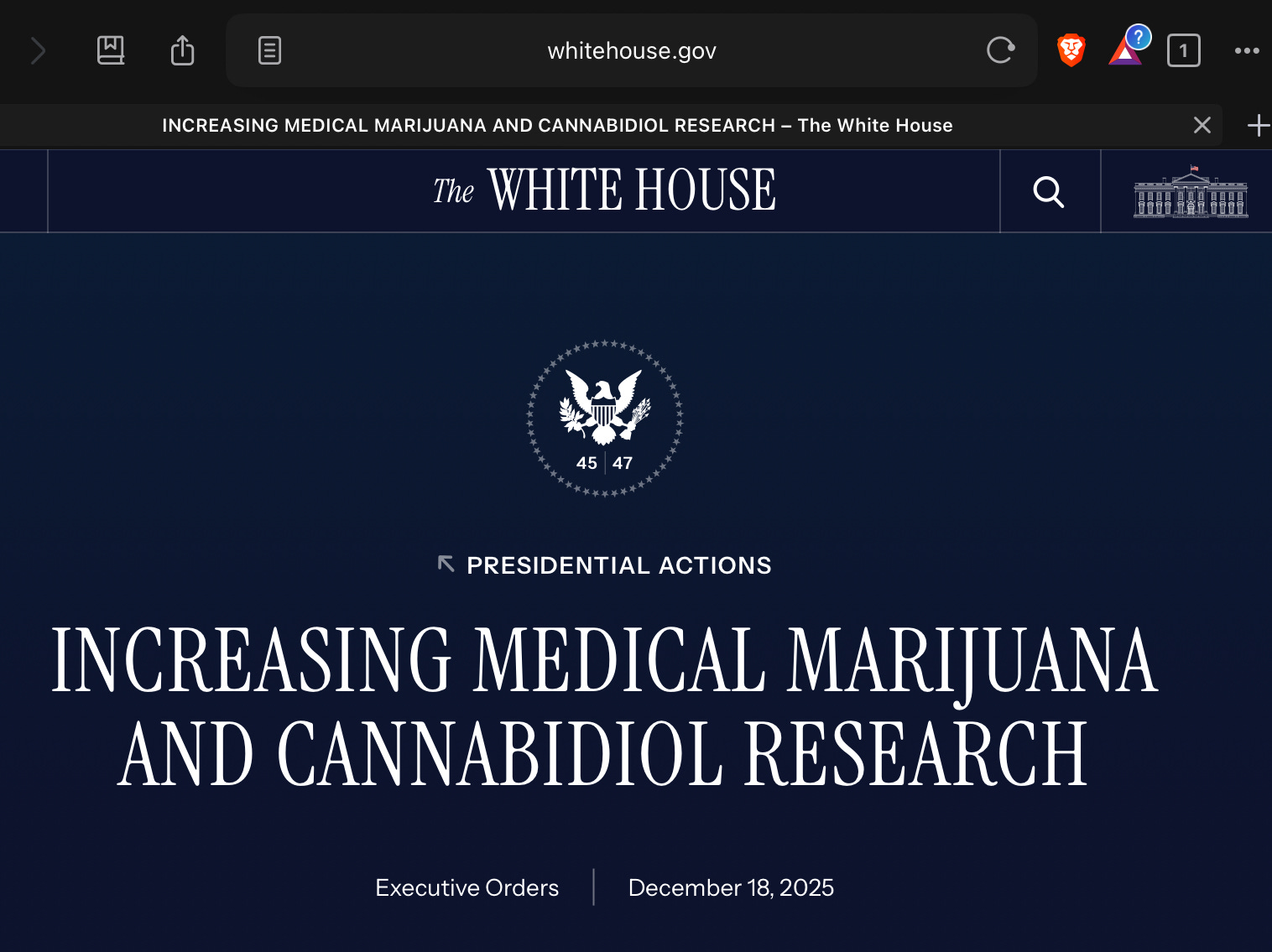
Today’s executive order expanding medical marijuana and cannabidiol research is not a breakthrough. It is an admission.
When governments change course after decades of resistance, it is rarely because they were persuaded. It is because the old position has become impossible to defend.
Cannabis has reached that stage.
For years, federal cannabis policy rested on a single claim: that marijuana had no accepted medical use. That claim is now gone. Not debated. Finished.
The order does not legalize cannabis. It does not need to. It simply instructs the system to acknowledge reality and begin adjusting around it.
This is how change happens.
Gradually, then suddenly.
Power rarely moves first. It moves last.
Executives can redirect enforcement. They can reinterpret statutes. They can stop defending what no longer holds. They can open doors and step aside.
But executives cannot resolve contradictions written into law.
Banking rules are statutory. Tax law is statutory. Interstate commerce is statutory. Section 280E is not a policy preference. It is a line in the Internal Revenue Code. An Attorney General can move pieces on the board. Only Congress can change the board itself.
Executives loosen. Legislatures settle.
The courts are already circling
When law drifts too far from lived reality, courts become the place where contradictions surface.
Medical cannabis patients recognized by their states are still stripped of constitutional rights under federal doctrine. Gun rights cases for medical patients are not about firearms. They are about legitimacy. A substance cannot be recognized as medicine and simultaneously serve as the basis for civil disability.
Courts dislike incoherence. They resolve it.
Criminal justice is not separate from reform. It is the debt
For decades, cannabis prohibition filled jails, fractured families, and permanently marked lives. Enforcement was not evenly applied. Entire communities absorbed the cost while others quietly benefited from eventual legalization.
Any serious federal reform that recognizes cannabis as medicine must also confront the punishment that accompanied its denial. Rescheduling without repair is not justice. It is amnesia.
Expungement, sentencing review, and reintegration are not side issues. They are the moral ledger attached to prohibition. And the executive branch can do more on this.
The heroin paradox tells you everything
Heroin is illegal.
Morphine, oxycodone, hydromorphone, fentanyl are legal, prescribed, reimbursed.
Same receptors. Same risks. Different framing.
Federal drug policy was never about chemistry. It was about control.
Cannabis broke the model because its therapeutic value cannot be cleanly separated from the plant itself. There is no neat handoff to a patented molecule without first suppressing the plant.
So suppression came first.
Pharmaceutical interest follows inevitability, not justice
For decades, powerful interests lobbied to keep cannabis research frozen. Schedule I was not an accident. It was a moat.
Now that the wall is cracking, the strategy shifts. Isolate compounds. Patent delivery systems. Marginalize the whole plant under the language of safety and standardization.
This pattern is old. What matters is memory.
Never forget who insisted there was no medical use when patients already knew otherwise. This is not an invitation to reassert control. It is a reckoning.
Does Congress still have to act?
Yes. If we want coherence.
Executives can open doors. Courts can force contradictions into the open. But only Congress can align banking, taxation, commerce, and criminal justice into a single framework.
Until then, cannabis policy remains unstable. Accepted but penalized. Recognized but incomplete.
That instability benefits those who arrived late and punishes those who lived with the consequences.
This is not the Berlin Wall. It is the Iron Curtain.
It did not fall because of a single decision. It collapsed because the story holding it up stopped making sense.
Cannabis prohibition is in its late phase. The science has moved on. The states have moved on. The patients have moved on.
What remains is inertia and interest.
And those never survive forever.
Gradually, then suddenly.