

Last December, at the end of our first full year in operation, we placed a box on the counter labeled “$3 Joints.” Each one was made from a full gram of flower and the price included tax. There were no alternatives alongside it. Whatever was in the box that day was the option. The strain changed. The price did not. We did not promote it or explain it. We left the box where it was and said nothing.
Nothing about it was hidden. The box sat in plain view. Customers could see it, ask about it, and come back to see if it was still there. It was. Every single day.
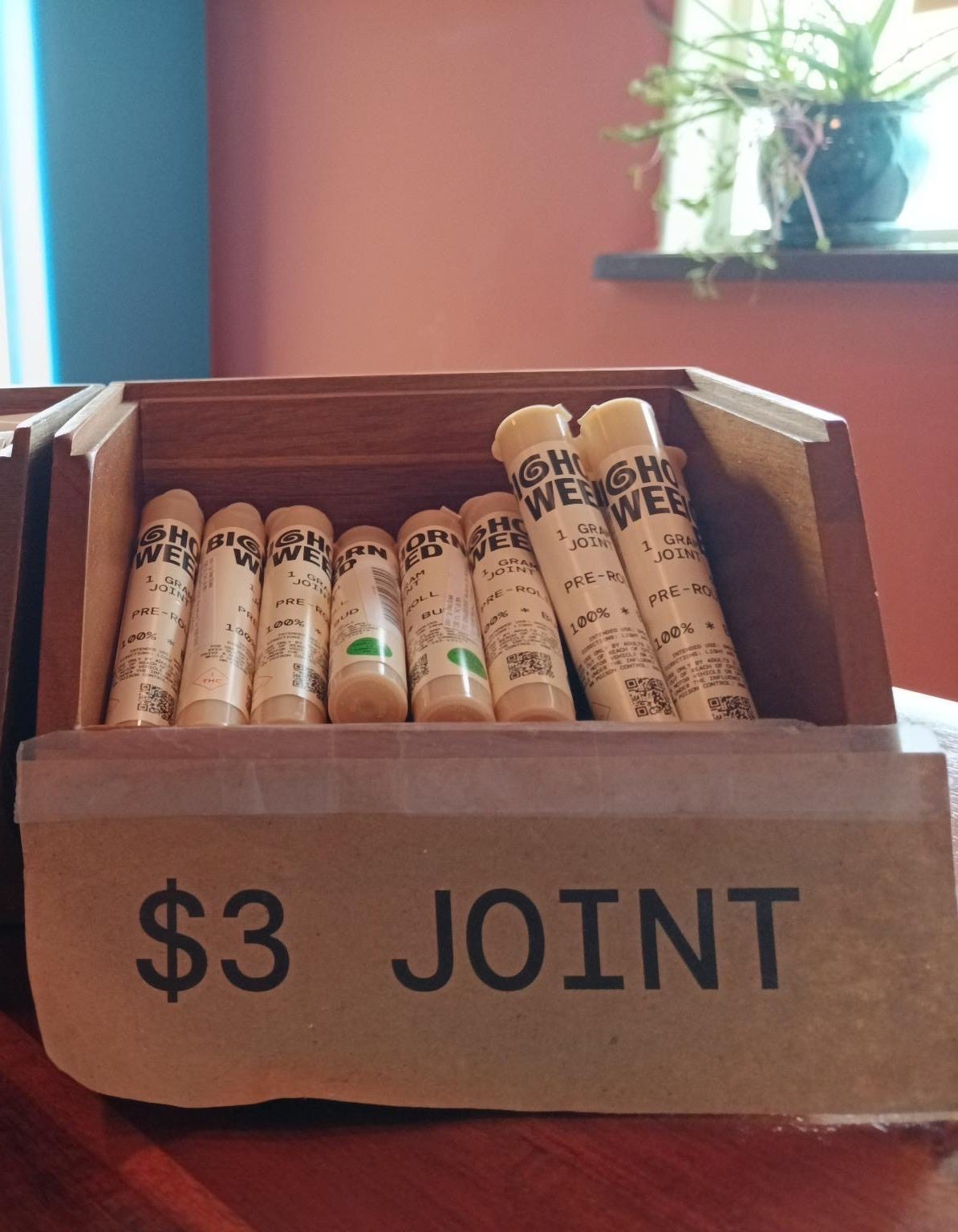
What was missing was choice. There was no menu to compare, no decision to optimize. The question was not which joint to buy. It was whether to take the one that was there.
What was also missing was attention. We never announced it. We never framed it as a strategy. For more than a year, it spread entirely by word of mouth.
In that sense, it existed covertly in plain sight. Everyone could observe it. And we had the sense that something consequential was happening.
The context around this was ordinary. The Taos cannabis market was becoming crowded in the way small markets always do. More shops, more incentives and discounts—often complicated ones—competing for the same attention. The pressure to market harder was obvious.
The $3 joint was not a marketing response to that pressure. It was an operational experiment. I wanted to see what would happen if an entry-level product were fixed in price and availability, and then left alone. No marketing. No urgency. No explanation. Something stable enough that customers could build patterns around it, and rigid enough that the organization would be forced to adapt around it.
Most cannabis businesses treat low-priced products tactically. They clear inventory, spike a slow weekend, or create urgency when something else is not working. Price becomes a lever to pull. I was more interested in what would happen if that lever were removed entirely.
A joint you sell occasionally can be improvised. A joint you sell every day cannot. Consistency stops being aspirational and becomes mandatory. Inputs must be reliable. Manufacturing must be repeatable. Production schedules must smooth out instead of lurching from rush to rush.
The $3 joint quietly reorganized the business upstream. In particular, it forced a more deliberate approach to sourcing high-quality sungrown flower. Not as a compromise, but as a foundation. Sungrown allowed us to work with larger, more predictable lots of organic flower and to build longer-term relationships with suppliers that understood consistency mattered more than novelty. Over time, our operation has become less reactive and more planned.
The effects were not dramatic in the way launches are spun dramatically for the street. There were no spikes, no announcement moments, no visible inflection points. No self-congratulations online. Instead, the constraints imposed by a simple promise began to shape everything around it. Fewer one-off SKUs. Fewer emergency production days. Shorter decision loops. Less noise.
Between our first and second full years of operation, the amount of flower we manufactured into finished products increased by nearly 100 percent, despite no corresponding increase in marketing spend, physical footprint, or pricing complexity.
That figure matters not because it signals healthy growth, but because it reflects a structural shift. The $3 joint did not merely increase demand for Bighorn Weed. It imposed operational discipline for our small business. It forced the organization to reorganize itself around reliability rather than hype. Convenience one can count on.
The fixed price did something else as well. It made our space accessible. Anyone could walk in knowing they could afford something. All day. Every day. In a moment when almost everything continues to get more expensive, we held one line steady. That choice quietly communicated something we never needed to say out loud. Everyone is welcome at Bighorn. There is always an option. No one needed to justify being here.
What surprised me was not what people said or even what they bought. It was how little deliberation remained.
Over time, the $3 joint stopped registering as a decision. It was not evaluated or compared. It was simply present. When people entered the shop, their movement adjusted around it. The question shifted from whether to buy it to whether to buy anything else.
None of this came from advertising. It came from deliberate constraint.
By holding price steady and removing choice, we eliminated a quiet but constant negotiation. People no longer had to calculate whether they had enough money, enough certainty, or enough context to make a purchase. It was no longer a question of whether someone belonged in the room. The answer was embedded in the environment of our shop before they arrived.
That shift is not an endpoint. It is an alignment. Product has flowed well through Bighorn since the beginning. What has changed is our willingness to observe that movement without interference and to learn from it. From there, the work is no longer about forcing demand. It becomes deciding—deliberately—what to build around it.